



WordPress themes can be customized to your heart’s content. Block themes have the native Site Editor for tweaking styles and templates. Classic themes use the legacy Customizer and accept custom PHP in templates. You can select the option that best fits your needs.
Yes, there are different approaches. However, all themes share at least one common file: functions.php
Developers can use functions.php to add custom code snippets. You can enable or disable specific WordPress features, or change how they work. The same goes for plugins like WooCommerce. Some themes include custom functions, which you can also edit via a child theme’s version of the file.
That’s only scratching the surface of what’s possible. A variety of custom functionality can be added here. That’s both a positive and a negative.
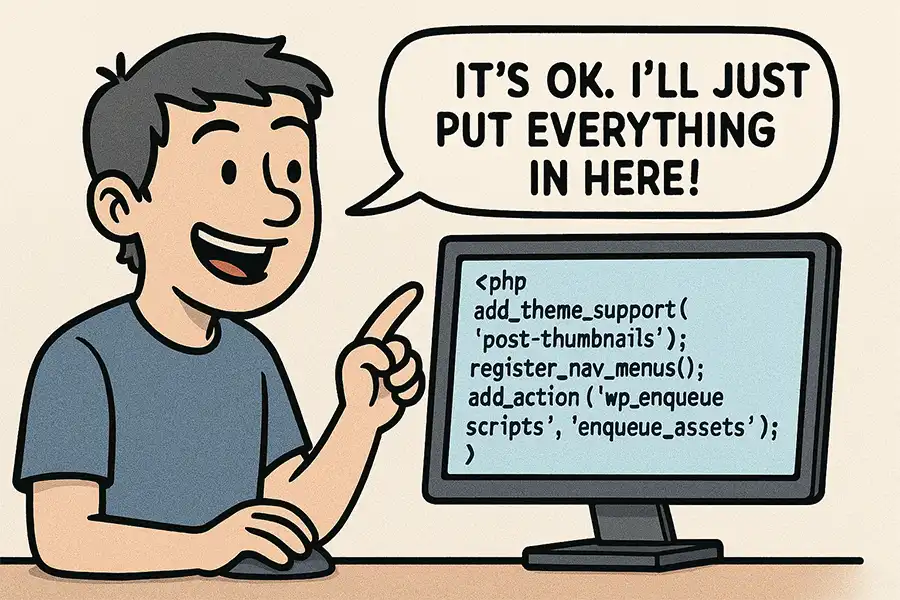
It’s great that the functions.php file is so versatile. The downside is that we often use it as the “junk drawer” of WordPress. It’s easy to fill the file with code that would be a better fit as a custom plugin. That could mean trouble as your site evolves.
So, how do you decide what to include and what to leave out of your theme’s functions.php file? Check out our best practices below.
A Repository for All Your Custom Code?
It seems like every WordPress development tutorial recommends placing code snippets in the functions.php file. Why is that? Well, it’s easier to explain than walking someone through building a plugin.
This technique works well enough. Most code snippets will run as expected. Plus, all your custom code resides in a singular file. It sounds like a winning solution.
But what happens if you change themes down the road? Those code snippets won’t migrate automatically. You’ll have to copy them to the new theme’s functions.php file. It’s an easy step to forget when redesigning a website.
Much depends on the specifics of your website, but you might miss some critical functionality. That could result in a myriad of issues. Everything from a buggy feature to a broken website is possible.
Project organization is also a concern. A file containing a random collection of snippets can be confusing. You might find yourself searching for code related to a specific feature or forgetting what’s there. It’s a recipe for future chaos, especially for large sites.
Thus, the negatives often outweigh the positives of using functions.php as a catch-all. It’s something to consider before opening the file and adding code.